Sunday, October 30, 2011

How film makers are using your own imagination to scare you

Happy Halloween!  It's a time of costumes, candy, and for those more thrill-seeking types, horror movies.

Personally, I'm a total wimp when it comes to scary movies.  Show me anything that's even trying and failing to be scary, and it will still scare me.  So that got me thinking, why is it you can walk into a movie feeling like this:
See this:
And suddenly feel like this:

After all, there's nothing inherently scary about that image.  It's just a forest at night.  But it's the fact that it's a forest at night in a scary movie that has me sitting on the edge of my seat.  This is a phenomenon called priming, wherein the fact that I know that this is a scary movie and scary things will happen will make me more likely to "fill in the blanks" of that scene with my imagination.  In other words, since I know something scary will probably happen soon after being presented the visual stimulus of the dark forest, I will begin to look for something to scare me in the scene when nothing inherently scary is there at all, while still proceeding to scare the living daylights out of myself.

Movie Magic!

Film makers are very, very aware of this phenomenon and they love to exploit it.  After all, it makes their job a lot easier.  If you can scare yourself by just imagining what's happening off-screen, then the film makers don't have to go through all the trouble and expense of actually showing you, and your imagination will almost always come up with something more horrifying than what they can show you on screen, anyway.  Movies like Paranormal Activity and The Blair Witch Project capitalize on this by showing you shaky, home-movie style shots and lots and lots of scenery without ever showing you the source of the threat throughout most of the movie.  The idea is that by presenting these otherwise neutral scenes with the implication of a threat intensifies the emotional reaction of the audience.

The Science

So what's actually going on in your brain while this is happening?  A recent study in Social Cognitive and Affective Neuroscience aimed to figure that out.  Researchers observed subjects' brain activity in a fMRI as they read two different types of sentences; one which implied a fearful situation, and another which was neutral.  In the fearful type of sentence, none of the individual words themselves were inherently fearful--that is to say that there were no words like "threat" or "hurt" or the like.  An example of one of the fearful sentences used in the study is "The boy was never found again."

In the next trial, the researchers showed the subjects neutral images (like a boy on a beach) and paired them with the fearful and non-fearful sentences.  In a final trial, the subjects were shown the images again, but without the sentences to see if the emotional memory of the images with the sentences would carry over without the presentation of the sentence.

The Results

When subjects were presented a fearful or non-fearful sentence with and without a picture, there were higher levels of activation in subjects presented a fearful sentence with and without a picture than in subjects shown non-fearful sentences with and without pictures.  These areas of activation were the middle temporal gyri, the temporal poles, and the left inferior frontal gyrus, which are associated with language processing and understanding.
Brain activity in people presented with fearful sentences
The researchers also found an additive effect in the right temporal pole when subjects were shown a fearful sentence with a picture (the right black bar) than when subjects were shown a fearful sentence alone (the left black bar).

The temporal poles, which are the front-most projections of the temporal lobe, are still poorly understood in their function.  However, they are connected to many structures in the brains emotional, or limbic, system and they have been implicated in the processing of emotion, and binding emotions to linguistic and visual stimuli (such as associating a fearful looking face with feeling fearful yourself).

So far, one brain structure has been conspicuously absent from this study on fear: the amygdala.  The amygdala is often referred to as the "fear center" of the brain, so why has it been so quiet up till now?  It would appear that the visual stimulus is necessary in this case to cause the amygdala to react to the fearful sentence.  Subjects who were shown fearful sentences with images had higher levels of activation in the right amygdala, whereas subjects who were shown fearful sentences without images had no activity above baseline in the amygdala.  This would imply that the amygdala does not necessarily interpret emotional salience from language alone, leading the researchers to conjecture that perhaps the amygdala can only be activated in this context with linguistic-emotional binding input from the temporal poles.

The amygdala also has an interesting role in the third trial of this experiment.  Researchers showed subjects pictures that were either previously paired with a fearful sentence, a non-fearful sentence, or no sentence at all, and monitored activity in their right and left amygdalae.  Pictures that had been previously shown with a fearful sentence led to a higher level of activation in the subjects' amygdalae than did pictures that were previously shown with a non-fearful sentence or no sentence at all.  This is in line with other evidence to show the role of the amygdala in emotional memory.  That is to say that when the image was previously shown with the fearful sentence, it was "tagged" by the brain as emotionally salient.  The presentation of the image again, even without the fearful component, will bring up the emotional flavor of the image, and lead to higher levels of activation in the amygdala.

Our brains are excellent at drawing connections between various stimuli in our environment.  We can take inherently un-emotional words, phrases, and images and combine them to form context and illicit emotion.  So the next time you go see a horror movie, take a moment to observe how artfully (or perhaps artlessly) the movie is taking advantage of and manipulating your own imagination to scare you even more.

Images courtesy of ragemaker, we <3 it, and Social Cognitive and Affective Neuroscience
Reference:
Willems, R.M.; Clevis, K.; Hagoort, P.  (2011) Add a picture for suspense: neural correlates of the interaction between language and visual information in the perception of fear.  Social Cognitive and Affective Neuroscience, 6(4), 404-416.

Sunday, October 16, 2011

Lizards!

Lizards.

I grew up in the North--first New Jersey and then I went to college in Oberlin, Ohio.  So when I recently moved down to Florida to start a new job, one of the most exciting things I found about my new location was the new fauna.  Particularly all the little lizards running around!  The most common lizards to Florida belong to the Polychrotidae family, and are generally known as Anoles.  However, "lizards" are a broad and diverse group, with many different species with very different morphologies and life styles.  Here are a few fun facts about lizards:


  • Lizards hear through the conduction of sound through small bones in their lower jaw vibrating a tympanic membrane (sometimes visible on the outer skin surface)
  • Some lizards have prehensile (grasping) tails that aid them in climbing.
  • Other lizards have more elongated tails that they can use for defense as whips.
  • Some only have two limbs, while others are limbless (not to be confused with snakes).
  • Some have webbed limbs and even specialized skin flaps that act as parachutes or gliders (I highly recommend that you go and watch that link, it's a really cool video from Animal Planet that I couldn't embed here.)
  • Some have specialized fringes on their toes that allow them to run on water!  (See video)


However, being a nerd I find one of the most intriguing things about all lizards is that--unlike us--they are ectothermic, or basically cannot internally regulate their own body temperature.  This is what is generally referred to by the term "cold-blooded," although that term is considered a bit archaic by the scientific community due to the fact that cold-blooded animals do not have cold blood.  In fact, most of the time lizards probably have blood that is warmer than the blood of "warm-blooded," or endothermic animals (i.e. mammals and birds).

In order to understand the implications of being ectothermic, we should first consider the importance of body temperature in general, regardless of how it is regulated within an organism.  At it's most reduced, life is the result of many physical and chemical interactions occurring within the cells and tissues of the body.  The chemical interactions in particular (such as the transcription of DNA into RNA, and the translation of RNA into proteins; the breakdown of proteins and fats by enzymes; and the break down of ATP into ADP for energy... the list goes on), will function most efficiently within a certain temperature range.  If that temperature is too low, for example, then all those processes happen much slower.

What is it like to not be able to physiologically regulate your own body temperature?  Well for one, it vastly limits the type of environment you can live in.  While there are a few lizards that live in higher latitudes and altitudes, most lizards live in very warm climates.  This is because in order to keep their body temperature within an ideal range (somewhere around 40° C), they have to bask in sunlight and on warm substrates to keep warm, and then get to shade or be able to bury themselves in colder dirt or sand when the surrounding environment gets too hot.  In this way, you could consider lizards as behaviorally regulating their own body heat, but they still lack the physiological mechanisms by which endothermic animals regulate their own body temperature.

As you may guess, the environment ends up playing a very large role in determining the lizard's activities throughout the course of the day.  But as with any trait, it wouldn't have lasted so many generations if there wasn't a significant benefit.  Endothermic animals, in order to maintain their high internal body temperature, must have a very high metabolism to produce enough heat.  This high metabolism needs to be powered by energy gained from food, so a significant amount of the animal's time and energy must be allocated into foraging just to maintain their metabolic rate.  Lizards and other ectotherms don't have that problem; none of their energy intake needs to be put towards generating heat, so they can spend less time foraging and thus can allocate their energy towards rapid growth, social behavior, and reproduction.

The social behavior is what personally intrigued me by the Anoles of Florida.  If you watch these little guys for more than a few minutes, you will probably see them bob their heads up and down and extend a red projection from their neck, known as a dewlap.  This general behavior is seen in male Anoles, and is thought to serve to both establish territoriality and dominance over other males, as well as to attract females.  Moreover, the specific factors such as number of body push-ups, head bobs, and the degree of extension of the dewlap can convey specific signals within the same species of Anole.  It is also thought that the color of the dewlap varies between species, and that Anoles are able to visually detect the differences in color.  Some lizards are even capable of detecting ultraviolet wavelengths, thus adding another dimension to the visual spectrum that we cannot see ourselves.  Accordingly, the dewlaps of these lizards are able to reflect UV light.

In addition to being able to communicate with each other visually on a wider spectrum of visible wavelengths than we can, lizards (and many other animals) are also able to communicate using chemical signals called pheromones.  While the jury is still out on whether or not humans use pheromones to communicate, it is pretty well known that lizards can emit and detect such chemical signals.  In lizards, there seems to be some differences in the methods by which the two sexes employ the chemical signals.  Males seem to emit pheromones to communicate with other males, whereas females use their pheromones in a more male-directed fashion.  Lizards are able to detect these chemical signals using their olfactory system (sense of smell,) their gustatory system (sense of taste) and another sensory system a little foreign to us, the vomeronasal system, which specifically detects pheromone chemicals.  In lizards, the vomeronasal ducts open to the mouth, and they use their tongues to pick up the chemicals and then flick them over the olfactory and vomeronasal ducts.  This is the underlying reason for the tongue flicking behavior that you probably associate mostly with snakes.

There is quite a bit more interesting information about lizards, particularly in the shapes of their skulls and how sound is conducted through their lower jaws.  But in the interest of not writing a whole book on the matter, I'll cut this post off here.  But now you know a little more about the crazy lives of lizards!

Reference and disclaimer
Most of the information I find for the posts I write on this blog comes from a combination of knowledge that I gained through classes and through internet sources.  I generally link to these internet sources in the text of my posts, but sometimes I also get information from books (those archaic sources.)  Most of the information from today's post came from Lizards: Windows to the evolution of diversity by Eric R. Pianka and Laurie J. Vitt (University of California press, 2003).  The rest came from my own notes or internet sources where linked.

Thanks for reading!

Monday, September 26, 2011

The Stopped Clock Illusion

Everyone can relate to this. You're in class, at work, waiting for something... you look at the clock and that first second that goes by seems to take forever. Then every second after that appears to progress normally. Why is that?

This is due to a phenomenon called saccadic masking or saccadic suppression. A saccade is the rapid movement of your eyes from one point of attention to another. To demonstrate this to yourself, hold out your two thumbs in front of you, and try to move your eyes smoothly from your right thumb to your left. You'll notice that your eyes don't move smoothly. Instead, they jump to points between your two thumbs along the way.

Saccades allow us to make a mental map of our surroundings and all the points of interest within it.  This is because the part of your retina directly behind your pupil, the fovea is packed with receptors that enhance visual acuity.

Cross-section of the eye, Wikimedia.

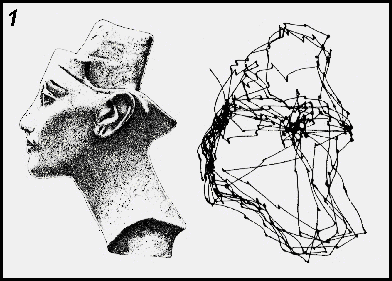
When you look around, your eyes don't span smoothly across the scene in front of you. Instead they move in saccades, quickly directing your fovea from one object of interest (the sharp corner of that table that you don't want to walk into) to another (that cute guy/girl waiting for you at the other end of the room). Saccades also occur when focusing on the details of a single image, as demonstrated by these eye movement traces of subjects as they examined the bust of Nefertiti.

Source: MIT


What you don't notice in between these saccades is well, anything.  The saccade itself is so fast that your brain doesn't have enough time to process the information coming to it to make a clear image.  A blurry image isn't too helpful and would probably just give you motion sickness.  In fact, the shaky "hand-held" camera effects in the movie Cloverfield did just that to many of its viewers.

So then what does your brain do with the information sent to it during a saccade?  Nothing; this is what is meant by the terms, saccadic suppression and saccadic masking mentioned earlier.  Even though the eyes are sending information to the brain, the brain does not process the information, leaving you effectively blind during a saccade. However, saccades are not so fast that you wouldn't notice the lapse in vision. What's going on? You don't actually perceive being blind during a saccade but you also don't see the blurry image, so what are you seeing?

It turns out that once you've fixed your fovea on an object, your brain actually tells you that you've been looking at it from the beginning of the saccade.  You don't notice this difference in timing at all, unless of course that object of your gaze actually keeps time.  So even though you're focused on the clock for only a second, your brain is telling you that you've been focusing on the clock for the 1,000 milliseconds it takes the second hand to move plus the time it took for your eyes to move to the clock.

On average, a saccade takes about 100 milliseconds, or about 10% of one second. So if you happen to look at a clock right at the beginning of a new second, it will appear to take 10% longer than normal, resulting in the famous illusion known as Chronostasis, or the stopped clock illusion.

Sunday, September 11, 2011

Lucid dreams

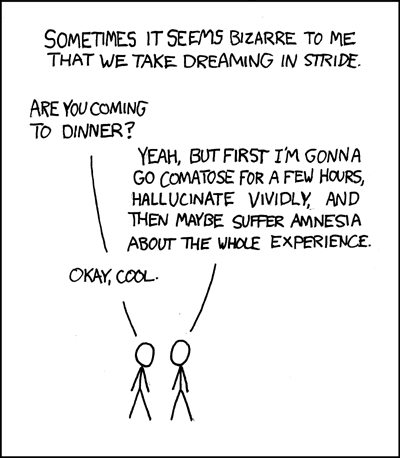
xkcd

Most of the time, when we dream we are not consciously aware that we are dreaming.  Despite the often fantastic circumstances of the dream, we accept that the events and experiences that are happening to us are real.  At least until we wake up.

Lucid dreaming, or the awareness that one is dreaming, is a fairly well-known, and well-documented phenomenon.  Most people report having at least one lucid dream in their life, but for the most part they are considered to be very rare occurrences in the overall population.  However, lucid dreaming was not always a well-accepted fact of life, and of course is still contested by some sleep researchers today.

The term, "lucid dreaming" was originally coined by the Dutch psychiatrist, Frederik van Eeden in 1913,  but reports of lucid dreaming have been documented since Aristotle's time.  For the better part of the history of research on dreams and sleep many people believed that lucid dreams were not dreams at all, but were the result of brief moments of consciousness due to transitory awakenings that are common during REM sleep.

Then along came Alan Worsley.

Alan Worsley is a bit of a lucid dreaming celebrity in the field.  A graduate student in psychology, Worsley had been developing his own ability to dream lucidly.  He was able to plan experiments while awake, and then recall and carry out the protocol once dreaming.

During REM sleep, your body paralyzes the motor activity eminating from the spinal cord.  This is thought to be because during dreaming motor activities are initiated in the brain in response to dream stimuli, but then they are not propagated beyond the spinal cord so that this (usually) doesn't happen:
However, it is known that not all motor functions are cut off during dreaming.  The most obvious being the eye muscles (hence, Rapid Eye Movement) and respiratory muscles.  Alan Worsley used this information to signal to an observer in the lab that he was dreaming and aware of it by moving his eyes left and right a pre-agreed upon number of times.  By carrying out this procedure with no lapse in sleep activity (as monitored on an electroencephalogram (or EEG)), Worsley effectively proved that lucid dreaming is a physiological reality.

Since Worsely many people have become skilled in lucid dreaming, and indeed it has become accepted as a skill that most people can learn with practice and patience.  For most people, lucid dreams initiate when something in the dream is so outside the normal realm of reality that it becomes abundantly clear to the dreamer that he or she is dreaming.  You may think that something like a blue whale passing overhead like a blimp might be the sort of stimulus needed to induce that sort of awareness, but really it may in fact be something more mundane that suddenly jolts you into awareness.  In the clip from Waking Life that I posted a couple weeks ago, one of the characters suggests turning a light switch off and on.  In fact, this is a common method used by lucid dreamers to test waking vs. dreaming states of consciousness.  Worsley and other lucid dreamers often report that light levels are hard to adjust in dreams, so turning a light switch on and off is a quick and easy way to test if you are dreaming.  If it's a habit you can build in waking life, then you may find one day you try it and the results aren't what you expect, and from there it could be reasonable to conclude that you're dreaming.

Lucid dreaming can also be used as a valuable tool for studying consciousness and its properties both in the waking world and the dream world.  In particular, it's interesting to test what can be done in the dream world.  Since it exists purely in the mind, one would think that lucid dreaming allows you total control over the circumstances of your dream and you can essentially play God.  But in practice, most people seem to have limits to control over their dreams.  The light switch is one example, and reflections in a mirror are another.

In one study, dreamers were asked to find a mirror and view their reflection, and then to try and walk through the mirror.  Most participants could find the mirror and view their reflection with ease, however most participants also reported distortion in the image they saw in the mirror.  When they tried to walk through it, slightly less than half were successful in doing so.  What was on the other side varied from person to person.  One participant reported coming up from the bottom of a lake after entering the mirror.  Others reported moving through the mirror but then ending up back in the same room.

While this is cool and all, the fact still remains that most of the participants could not walk through the mirror.  Why?  It's a dream so anything should be possible.  That's something we generally believe even when dreaming non-lucidly.

The element of control may be in some way related to the level of lucidity.  Up until now I have been talking about lucid dreaming as a distinctly different type of dreaming from non-lucid dreaming.  But modern research shows that there is a continuum between states of lucidity in dreaming, and that this continuum affects the ability of the dreamer's control over the events of the dream.  Theoretically, if one can learn to dream lucidly, one could probably learn to master control over the events in the dream once lucidity is achieved.  And then who knows what you could be capable of.

But first, just try to turn the lights on and off.

Sunday, August 28, 2011

In lieu of lucid dreams

Last night I dreamt that I was in a city that was slowly being overrun by zombies.  This was, no doubt, a result from the fact that I had watched three straight episodes of The Walking Dead just before going to bed.  Anyway, the dream slowly turned from avoiding these zombies to taking a train to the country to run away from my family.  Apparently somewhere along the way I became a princess or some type of nobleperson, and I wanted to escape my responsibilities by living a simpler life in the country.  But when I got there, the country was not what I thought it would be like, and it was instead full of people just like the ones I was running away from.

(To my family reading this, my dream family was not the same as my real family, don't worry.)

When I got up this morning, I knew I wanted to write something about sleeping, and eventually I settled on writing about dreaming and specifically lucid dreams.  But when I started to do the research, I realized that there was a whole lot of information out there, and I decided I really wanted to take the time to comb through it and actually write something decent and interesting.  So a post on lucid dreaming is forthcoming.  In the meantime, here's a little review on a book I recently read about mutants.  Not like X-Men mutants, I'm talking about genetic mutations that cause dwarfism, albinism, conjoined twins, etc.

This book aptly titled, Mutants, by Armand Marie Leroi, begins with historical accounts of monsters and demons, and seamlessly and effortlessly begins to speculate on the possible genetic diseases that may have been behind these "monsters."  From there, he begins to delve into accounts of more familiar curiosities such as conjoined twins and little people.  All the while, Leroi explains how the study of the people whose bodies and genetic codes differ from the norm can shed light on our understanding of what "normal" really is, anyway.

Leroi's writing style is quite nice, as well.  He manages to describe the physiological processes involved in these mutations without being overly dry and scientific.  Rarely does a science book grab and hold my interest as well while being as detailed as Mutants.  However, I should also state that I did feel like having a background in biology helped a lot when reading this book.  It's not that Leroi's writing isn't clear and to the point, but his subject requires a description of certain processes like DNA replication, or the course of early embryonic development.  Without some background in these subjects, and certain mental diagrams to draw from, a reader could easily get lost.  I would probably not recommend this book to someone who has no scientific background whatsoever, but if you've taken biology at the college level then you will probably understand everything in this book just fine.  And it even has the added benefit of having some shocking photos of some of the subjects described in the book, which can be really fun when you read it on a plane like I did, and you can potentially scare your neighbors.

Here's a sneak peak on the kind of stuff I'll be talking about on my next post (probably two Sundays from now).  This is a clip from this really excellent, really trippy movie, Waking Life, in which the main character slowly realizes that he's dreaming.  This scene in particular is when he begins to realize his situation.


Disclose.tv - Clip from Waking Life (Lucid Dreaming Movie) Video